
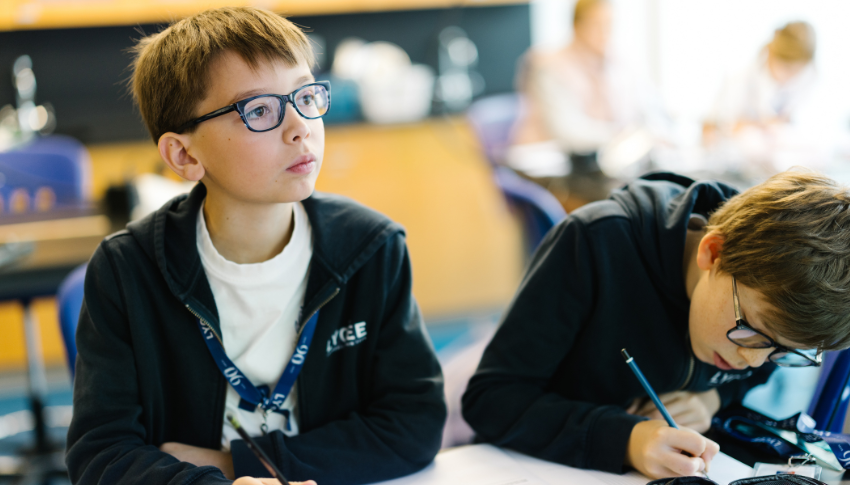
With advancements in cognitive science, we now have a better understanding than ever of executive functions—those brain mechanisms that are essential to academic, social, and professional success. Even better, we know that these skills are not innate and can be developed throughout childhood and adolescence.
This year, from January 5 to 7, 2026, the Lycée Français de New York marked our own Bilingual Brain Week with a special guest, Dr. Grégoire Borst, Professor of Developmental Psychology and Cognitive Science of Education at Université Paris Cité, by highlighting these scientific discoveries and our new initiatives designed to help students benefit from them.
Executive Functions: More Than Intelligence
The work of Dr. Borst has greatly enriched our understanding of executive functions, which he describes as the brain’s “conductor.”
These mechanisms are essential to academic, social, and professional success because they support goal-setting and goal achievement. They include:
- Emotional regulation, which enables students to live harmoniously in a group, collaborate, stay engaged, and persevere.
- Working memory, which allows students to retain and manipulate information over short periods of time—for example, keeping instructions in mind while carrying them out.
- Inhibitory control, which refers to the ability to resist distractions, curb impulses, and remain focused on the task at hand.
These functions are not innate; they develop gradually into adulthood, making childhood and adolescence a crucial period for nurturing them.
Dr. Borst’s research shows that executive functions have a greater impact on academic success than IQ. A student with strong cognitive abilities but weak executive functions may face significant challenges, while a student with well-developed executive functions has valuable tools to compensate for potential learning difficulties.
Meditating to Strengthen Executive Functions
In addition, numerous studies indicate that mindfulness meditation benefits the executive functions of children and adolescents. It improves focus, helps manage stress, impulses, and frustration, and encourages openness and self-awareness.
For this reason, in 2025 the Lycée Français de New York chose to integrate mindfulness meditation into the daily lives of elementary school students. Eline Snel, a Dutch therapist and pioneer in teaching mindfulness to children, is supporting us in implementing this new tool in service of student success. Read our related article to learn more.
Strengthening Our Teaching Practices
In 2026, Dr. Borst is working directly with our entire teaching staff through training and discussion sessions aimed at deepening our understanding of cognitive science and translating research findings into concrete classroom practices.
As part of Bilingual Brain Week, Dr. Borst’s visit offered a unique opportunity for observation, dialogue, and collaborative pedagogical development. During this visit, he also led conferences for students and for families, introducing them to advances in cognitive science, the importance of executive functions, and ways to extend the school’s work at home.
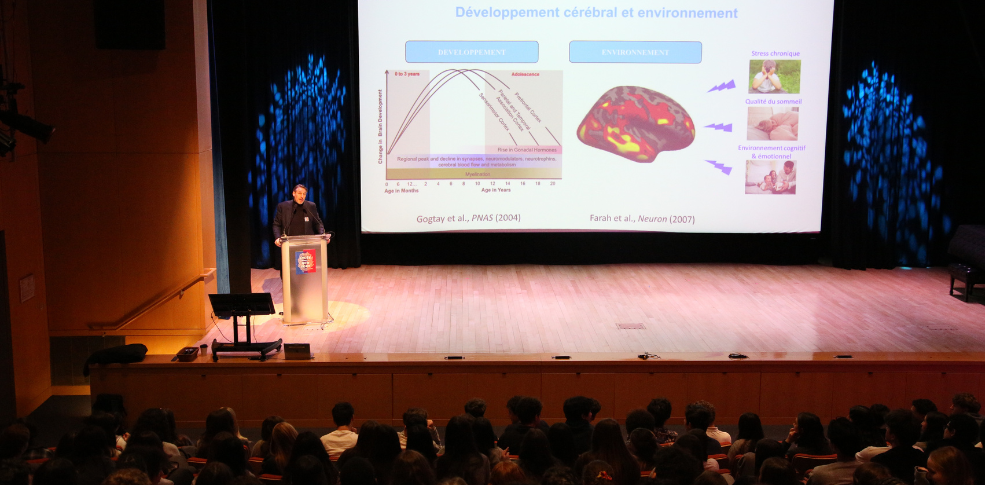
Like our work with Eline Snel, this collaboration with Dr. Borst is a true long-term partnership. It allows us to ground our practices in the latest research, connect science with classroom reality, train our educators, and engage families. Together—researchers, educators, families, and students—we are building a school where every child can fully develop their potential.
Recommendations for Parents
If you would like to support the development of your children’s executive functions at home, here are a few suggestions based on our experience and on current research:
- Ensure your child has consistent, solid sleep. Dr. Borst reminded us that good, consistent sleep is the most important key to student well-being, brain development, and learning. For children ages 6 to 13, from 9 to 11 hours a night is advised; for children ages 13 to 17, 8 to 10 hours a night is advised.
- Introduce your child gradually and consistently to meditation through short practices: 2 to 5 minutes a day is more effective than 30 minutes once a week.
- Create a supportive environment: reduce sources of distraction and establish clear routines.
- Celebrate effort and progress: praise children not only for results, but especially for their efforts and the strategies they develop. This approach strengthens their sense of control and intrinsic motivation.
About the Author :
Vannina Boussouf grew up on the Mediterranean island of Corsica, where bilingualism is an integral part of identity. She studied English and Spanish at the University of Corsica, and philology and letters in Cordoba, Spain, before starting a career as an elementary teacher and administrator. Vannina relocated to the United States in 2004, where she taught at the International School in Louisiana. She joined the Lycée in 2007 to direct the Primary School, and during her tenure, she has focused on innovative teaching methods that support the development of the whole child in a bilingual setting.